Chiro Connect
You order a stack of reactivation postcards, mail them to every patient who’s gone quiet, and wait. A few trickle in. Most don’t. So you file reactivation under “tried it, didn’t work.” But the postcard didn’t fail because patients stopped believing in their care. It failed because a postcard isn’t reactivation. It’s a guess in an envelope.
Do chiropractic reactivation postcards actually bring patients back?
Rarely, and not for the reason most docs assume. The patient didn’t lose faith in chiropractic. They fell out of rhythm, life got busy, the pain quieted down, and nobody reached back out at the moment that would’ve pulled them in. A postcard lands in a pile of mail weeks later, says something generic about wellness, and asks for nothing specific. It doesn’t know when they dropped off or where they left their care. Reactivation isn’t a mailing you send. It’s a system that runs on timing.
Try this: Pull your last 50 patients who haven’t been in for over 90 days. Ask one question about each. Do you know the exact date of their last visit? If you don’t, a postcard was never going to reach them at the right time, because you didn’t know what the right time was.
Why don’t reactivation postcards work?
They miss on the three things that actually move a lapsed patient: timing, relevance, and follow-through. A postcard gets none of them right.
-
Timing. Postcards go out when you remember to order them, not when the patient hit the window where they’re most likely to return. By the time it arrives, the moment’s usually gone. Try this: Stop thinking in batches. A patient who lapsed in March and a patient who lapsed last week need to hear from you on different days, not in the same mail-out.
-
Relevance. A postcard says the same thing to everyone. The maintenance patient who faded, the new patient who never finished their plan, and the one who quit after the first missed appointment are three different problems. One generic card speaks to none of them. Try this: Sort your lapsed list by why they left, not just when. The message that brings each group back is different.
-
Follow-through. One touch isn’t reactivation. People come back after a sequence, not a single nudge that’s easy to ignore. A postcard is a one-shot by design. Try this: Map what happens after the first message goes unanswered. If the answer is “nothing,” that’s your real reactivation gap.
When should you reach out to a patient who’s gone quiet?
The 60 to 90 day window after their last visit is the sweet spot. Earlier and they don’t feel gone yet. Much later and the habit’s fully broken, the relationship’s cold, and you’re closer to starting over than reactivating. Most practices wait until a patient’s been gone six months or a year, which is exactly when a postcard, or anything else, has the least chance of working.
Try this: Set a single trigger at 60 days since last visit. That one marker does more for reactivation than any card you can print.
What actually brings a lapsed patient back?
A timed, personal message that names where they left off, sent through a channel they actually open, and backed by a sequence if the first one goes quiet. A well-run patient email gets opened at 50 to 70 percent. A postcard gets a glance on the way to the recycling bin. The difference isn’t the format for its own sake. It’s that email lets you reach the right patient on the right day with a message that sounds like it came from their chiropractor, not a print shop. Reactivation works when it remembers the patient. Postcards can’t remember anything.
Try this: Take your strongest postcard line and send it as a short, plain email to one lapsed patient, timed to their 60-day mark, signed by the doctor. Watch what a real touch at the right moment does.
Inside Chiro Connect
We don’t send postcards. We run reactivation as a timed system, because that’s what brings patients back. Every practice we work with gets weekly newsletters that keep patients warm so fewer of them ever go cold, monthly check-ins, new patient welcome campaigns, and reactivation campaigns built to hit that 60 to 90 day window. The system remembers each clinic, each town, and each patient’s history, so the message that goes out sounds like the doctor wrote it on a slow afternoon, not like a mass mailer. It’s human-powered and done-for-you, refined across more than 1,000 chiropractic practices. The doc doesn’t order anything, print anything, or remember to follow up. The system handles the timing. They keep adjusting.
What This Means for You
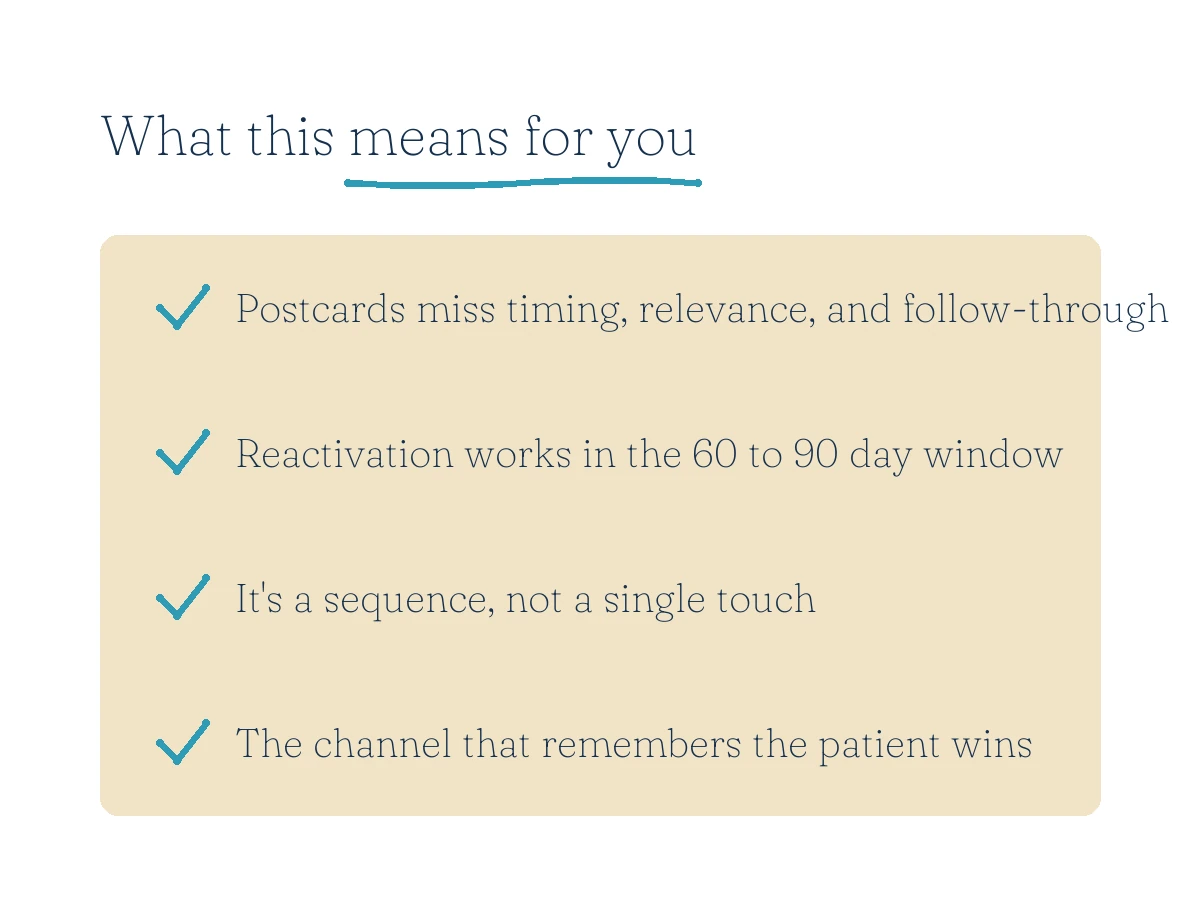
- ✓Postcards fail at reactivation because they miss on timing, relevance, and follow-through, not because patients stopped believing in their care
- ✓The 60 to 90 day window after a patient's last visit is when reactivation actually works
- ✓Reactivation is a sequence, not a single touch, and it has to know where each patient left off
- ✓The channel that remembers the patient beats the one that forgets them every time
Pro Tip: Before you spend a dollar on reactivation, find out whether you even know the last-visit date for every patient who’s lapsed. The timing is the whole game. If your system can’t tell you who hit 60 days this week, no postcard, email, or campaign will land when it needs to.
Frequently Asked Questions
Do chiropractic reactivation postcards work?
Not well. A postcard is a single, generic, untimed touch. It can’t reach a patient at the moment they’re most likely to return, it says the same thing to everyone, and it stops at one try. Reactivation works when it’s timed to the patient and runs as a sequence, which a postcard can’t do.
What’s the best way to reactivate lapsed chiropractic patients?
Reach the patient inside the 60 to 90 day window after their last visit, with a personal message that names where they left off, sent through a channel they open, and followed by a sequence if the first message goes unanswered. Timing and relevance matter more than the format.
When is the best time to reactivate a patient?
Between 60 and 90 days since their last visit. Before that they don’t feel gone. Long after that the habit’s broken and the relationship’s cold, and you’re closer to re-acquiring them than reactivating them.
Is reactivation the same as patient retention?
No. Retention keeps active patients from drifting in the first place. Reactivation brings back the ones who already left. They’re separate systems with different timing, and a practice needs both. You can read more on our patient reactivation page.